Economic & Political Systems Institute
Inputs for a New Economy

Coming soon: The New Economy Evaluation Cohort (NEEC)
mission & approach
EPSI Inputs
The EPSI’s mission is to help a New Economy paradigm prevail over competing alternatives, in the shortest possible timeframe.EPSI Inputs are designed to support organisations already working in the New Economy space. The first EPSI Input is the New Economy Evaluation Cohort (NEEC).Initial feedback on the NEEC concept from staff of New Economy organisations has been strongly positive. The current version of this website has the purpose of supporting further engagement with- Leadership and staff of New Economy organisations;
- Professional evaluators, and
- Potential fundersuntil the NEEC is set up and ready to launch.Please read on for further details including the NEEC problem definition and Theory of Change. To sign up for updates please click here.
NEW! May 2026: EPSI Concept Notes #2 and #3 now availableEPSI Concept Note #2
Understanding Systemic Transitions: Towards a Conceptual FrameworkIn the New Economy field, historical analysis of paradigm change is weighted towards twentieth century examples, in particular the period leading up to the shift towards neoliberalism in the early 1980s.This concept note proposes to develop and test a conceptual framework that can be applied to transitions between systemic paradigms across time.EPSI Concept Note #3
A Common Strategy Language (CSL) for New Economy organisationsWhen organisations disagree on what strategy is, chances they will agree on what a strategy should be are low.Concept note #3 suggests a Common Strategy Language to help reduce friction among New Economy organisations when working towards shared objectives.
context
The System Change & New Economy field
System Change is increasingly viewed as a pre-condition to tackling the greatest challenges of our time: the climate crisis, inequality and the rise of authoritarian politics. As Mariana Mazzucato has summarised: “This isn’t just about tweaking policies at the margins—it’s about redesigning the economic system itself.”The System Change & New Economy field has grown rapidly in the last decade, with at least 700 initiatives in Europe alone.Landscape reports have highlighted a strong degree of agreement around high-level goals and principles within the field.At the same time, they have found a number of persistent gaps, including the limited capacity of New Economy organisations to develop shared strategies.
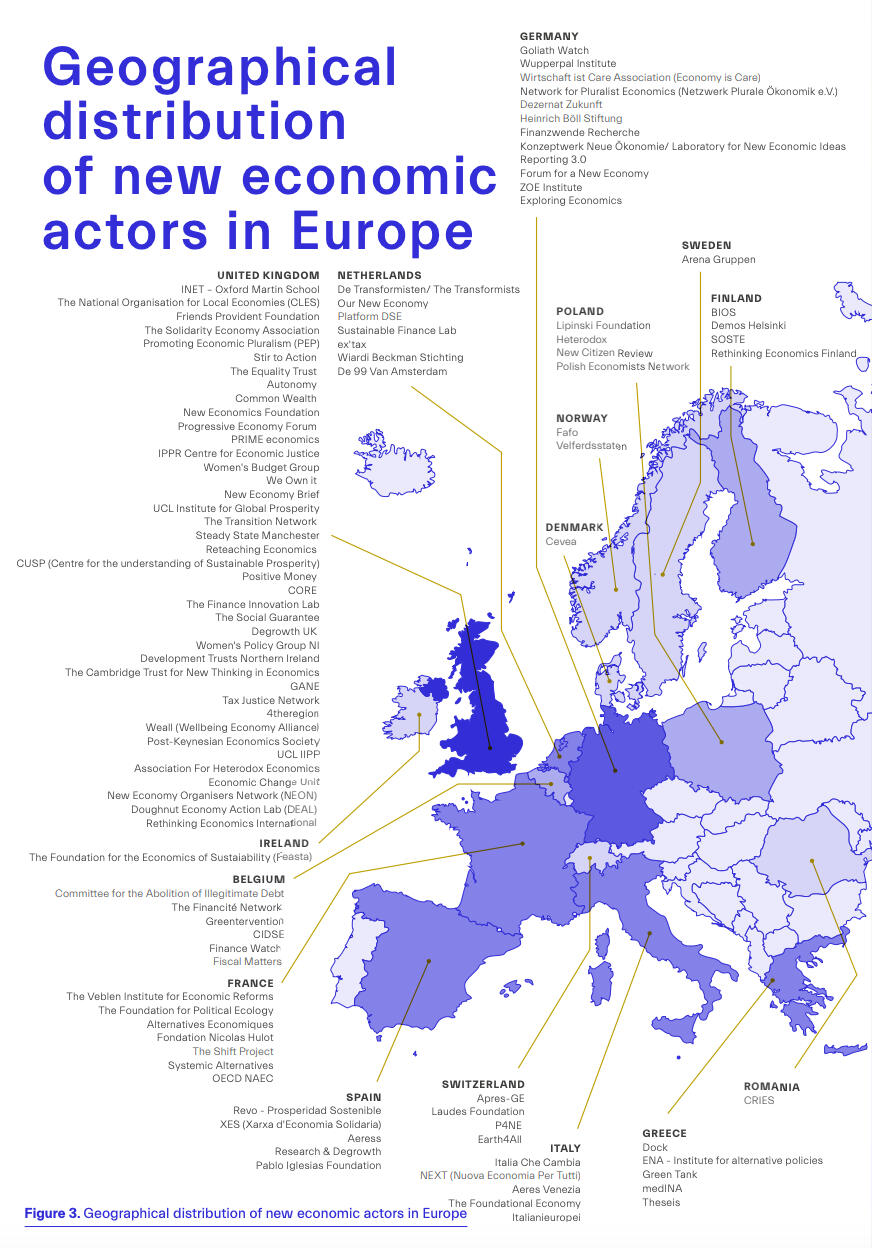
A partial overview of the New Economy field. Source: Demos Helsinki
Problem definition
Why structured evaluation matters for a New Economy
A systematic review of the websites of New Economy organisations found no published evaluations of organisations' own work (EPSI 2026, forthcoming).Publication of evaluations is considered good practice as an indicator of an organisation’s overall approach to learning and strategic adaptation. Beyond publication, regular evaluation is itself widely understood as an essential condition for organisational effectiveness. For example:'The ability to evaluate and measure progress… is a prerequisite if an organization is to learn from its mistakes and successes, in order to improve its performance.'In bilateral communications, staff of New Economy organisations have confirmed that to their knowledge structured evaluation is uncommon in the field. They also noted that many New Economy organisations are new and relatively small, lacking the resources for structured evaluation and learning.Previous research has found that the approach to evaluation among New Economy organisations (in German-speaking countries) is largely driven by donor requirements and linked to restricted funding.The limited availability of evaluations in the New Economy field suggests organisations may have insufficient inputs to engage in structured reflection and adaptation, both internally and with peers and other stakeholders. Building effective networks is in itself an important adaptive capacity.The frequently cited problem of insufficient core funding in the New Economy field can also be linked to the need for evaluation.Guidance on core funding notes that it is not usually linked to specific project or campaign outcomes. Where funders provide core or unrestricted support, it is because they have trust in an organisation's overall capacity to develop and deliver effective strategies, and to adapt its approach over time as needed.Volunteering for structured evaluation can send a powerful signal of an organisation's long-term commitment to strengthen its own capacity. Evaluation findings can also provide independent inputs needed for informed discussions with (prospective) funders.
neec
The New Economy Evaluation Cohort
The NEEC is designed as a small cohort of 3 to 5 New Economy organisations voluntarily being assessed by professional evaluators. Each NEEC member organisation decides which aspect of their work or organisation to have assessed. The evaluations run independently but simultaneously, following a shared timeline and a common learning framework.The NEEC learning framework supports exchanges within the Cohort and the sharing of lessons learned with the broader New Economy field.
NEEC Tracks
The NEEC runs on two parallel and interconnected tracks:Track 1: Evaluations of Cohort member organisationsEach organisation is paired with an experienced evaluator or evaluating team according to the purpose and context of the evaluation. The evaluators will apply assessment methodologies that fit the organisation, its work, and the evaluation objectives.Publication of the evaluation reports of individual member organisations is encouraged but not required.Track 2: Collective learning at the Cohort levelThe Cohort is designed for shared learning. It will include a common NEEC learning framework, a shared timeline with Cohort-level milestones, and a common evaluation terminology.A collective Cohort lessons learned report with public launch events is also part of this track.To see the summary NEEC Theory of Change (TOC) please click here (pdf). For a full version of the TOC please contact [email protected].
REQUIREMENTS AND OUTCOMES
NEEC Membership
The main requirements for NEEC membership are:- Leadership commitment, for example allowing evaluator access to relevant organisational data and to staff for structured interviews;
- Participation throughout the NEEC process, including in closed workshops with peer Cohort members;
- Contribution to the collective lessons learned report and related launch events.Expected NEEC Outcomes include:
strengthened organisational capacity of New Economy Evaluation Cohort (NEEC) members;
interest in applying structured evaluation from non-cohort New Economy organisations, and
NEEC members with increased ability to access long-term core funding.
Funding situation and next milestone
As of May 2026, the NEEC is not yet funded.The funding objective is for all evaluation-related costs for NEEC member organisations to be covered, including: fees for professional evaluators, travel to workshops and events, and staff time required to specifically support the NEEC process.To work towards this funding objective, the next milestone is a fully developed NEEC proposal by September 2026, including Cohort members. Potential donors will be updated on the NEEC progress at regular intervals.The concrete EPSI milestone output for September 2026 is a document or presentation introducing:
- The NEEC Theory of Change
- Cohort Members including leadership commitment statements
- Profiles of NEEC professional evaluators (engaged through framework agreements)
- Evaluation objectives and summary of proposed methodology for each Cohort member
- Timeline and milestones
- Learning framework overview
- Project management system
- Supporting materials
- Budget
- Legal and financial management aspects
About
The EPSI’s vision is a world in which a New Economy paradigm has prevailed over competing alternatives in practice.Its mission is to help a New Economy win in the shortest possible timeframe.The two driving questions for the EPSI as an initiative are:1) Is system change happening fast enough, considering the latest research-based probabilities and estimated impacts of climate breakdown?2) Are there policy and research contributions that could help to accelerate a transition to a New Economy and are still outstanding?
The EPSI Organisational Principles are:- Flexibility and adaptation
- Reliability and open communication
- Diversity of thought, experience and background
- Balancing action with reflection (‘reflectivist’ approach)
- Learning through doing
- Fast feedback through testing and evaluationThe principles are based on guidance on driving change in complex systems including How Change Happens and Working in Complexity.To test initial assumptions and avoid duplicating the work of New Economy organisations, in March and April of 2026 the EPSI ran a review that included desk research (report forthcoming) and feedback calls. The review resulted in an update to the EPSI approach, including EPSI Inputs as its main intervention method.The EPSI is currently in the founding phase (In Grundung) in Berlin, Germany, pending advice on its legal structure and fiscal hosting.
About
EPSI Coordinator
The EPSI coordinator is Max Heywood, previously Head of Policy & Advocacy at the Transparency International (TI) secretariat in Berlin. Over 11 years in non-profit advocacy, Max worked with multiple national change partners and global coalitions on the full project cycle: developing proposals; fundraising; implementing and managing project activities, and learning from independent evaluations.He was a regular speaker at conference panels, including at the IMF and OECD, as well as a media spokesperson for TI with appearances on Deutsche Welle and CNN. Max was also elected to chair the TI secretariat’s first works council (Betriebsrat), representing the interests of 190 staff.The EPSI evolved from a personal research project into post-neoliberalism and New Economy proposals. It is currently self-funded.

contact
Email: [email protected]
Mobile / Signal: +49 (0) 176 8033 0926
Impressum Data Protection © 2026 EPSI/Heywood. All rights reserved.